Shandong Fengtu IOT Technology Co., Ltd
Sales Manager:Ms. Emily Wang
Cel,Whatsapp,Wechat:+86 15898932201
Email:info@fengtutec.com
Add:No. 155 Optoelectronic Industry Accelerator, Gaoxin District, Weifang, Shandong, China


Sales Manager:Ms. Emily Wang
Cel,Whatsapp,Wechat:+86 15898932201
Email:info@fengtutec.com
Add:No. 155 Optoelectronic Industry Accelerator, Gaoxin District, Weifang, Shandong, China
time:2024-11-27 08:57:38 source:Weather Station viewed:543 time
When the fog is thick, it is particularly difficult to navigate ships in places like the Huangpu River where the waterway is narrow and the navigation conditions are complex. Due to the heavy fog, the pilots can hardly see the ships in the distance and the objects on the shore. At this time, relying on automatic identification systems, radars and other tools to locate and avoid other ships is somewhat useful, but they may also make mistakes when the weather is really bad. Moreover, such adverse weather conditions will make the crew very nervous and anxious, and their judgments are prone to errors, thus accidents are likely to occur.
At this time, it is of great importance to know the visibility. If the visibility situation can be clearly known, the ship can immediately take measures to deal with the thick fog. For example, turn on the navigation lights, fog lights and fog horns, ask the captain to rush to the bridge immediately, open the windows of the bridge to listen to the sounds of other ships, and inform others of the position, speed, direction and visibility of one's own ship via VHF, and discuss with the nearby ships about how to avoid collisions. Meanwhile, it is also crucial to report the visibility to the maritime department so that the maritime department can direct how the ships should navigate. If a ship underway feels it is unsafe to continue sailing, it can apply to the maritime department to find a safe place to drop anchor; for ships that are not underway, they must wait patiently for the fog to clear and listen to the instructions from the maritime department without sailing randomly. For ships that have dropped anchor and are stationary, knowing the visibility can also enable better watchkeeping. Keep the main engine ready for use at any time, monitor the situation of the surrounding ships, contact others via VHF in case of danger, and measure the anchor position frequently to prevent the ship from dragging anchor, colliding or running aground.
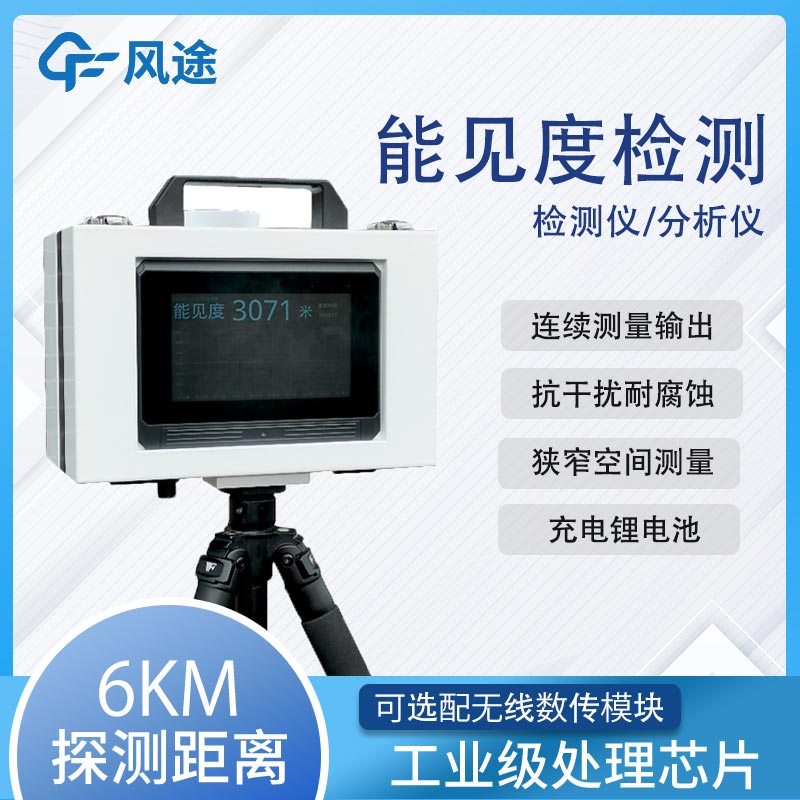
The Portable visibility detector comes in very handy at this time. It can be conveniently placed on the ship for use and can tell the crew the current visibility at any time. With this data, the crew will have a better idea when navigating in the thick fog. Whether it is during fog navigation, following the instructions of the maritime department or when at anchor, they can do things better according to this data, reducing the risk of accidents due to poor visibility and enabling the ship to sail more safely in the thick fog.
Agricultural Weather Station is a highly integrated, low-power, and rapidly deployable high-precision meteorological observation device designed specifically for farmland monitoring scenarios. Compliant with the requirements for high-standard farmland construction, the device comes bundled wit...
In the field of meteorology, visibility is a crucial observation indicator, usually accurately represented by the meteorological optical range. In the aviation field, the precise measurement of the Visibility detector can ensure the safety of aircraft takeoffs and landings; in the transportation fie...
The raindrop spectrometer is a high-performance meteorological sensor. Based on the principle of the attenuation of laser by precipitation particles, it can accurately measure parameters of precipitation particles (including liquid, solid and mixed states), such as diameter, velocity, and distributi...
As an important part of the power system, the safe operation of the transmission line directly affects the social and economic development. Therefore, in the actual production, it is necessary to do a good job in the maintenance of the transmission line to ensure that the transmission line has good...


 Skype
Skype
 whatsapp
 mail
mail