Shandong Fengtu IOT Technology Co., Ltd
Sales Manager:Ms. Emily Wang
Cel,Whatsapp,Wechat:+86 15898932201
Email:info@fengtutec.com
Add:No. 155 Optoelectronic Industry Accelerator, Gaoxin District, Weifang, Shandong, China


Sales Manager:Ms. Emily Wang
Cel,Whatsapp,Wechat:+86 15898932201
Email:info@fengtutec.com
Add:No. 155 Optoelectronic Industry Accelerator, Gaoxin District, Weifang, Shandong, China
time:2026-06-03 11:36:51 source:Weather Station viewed:9 time
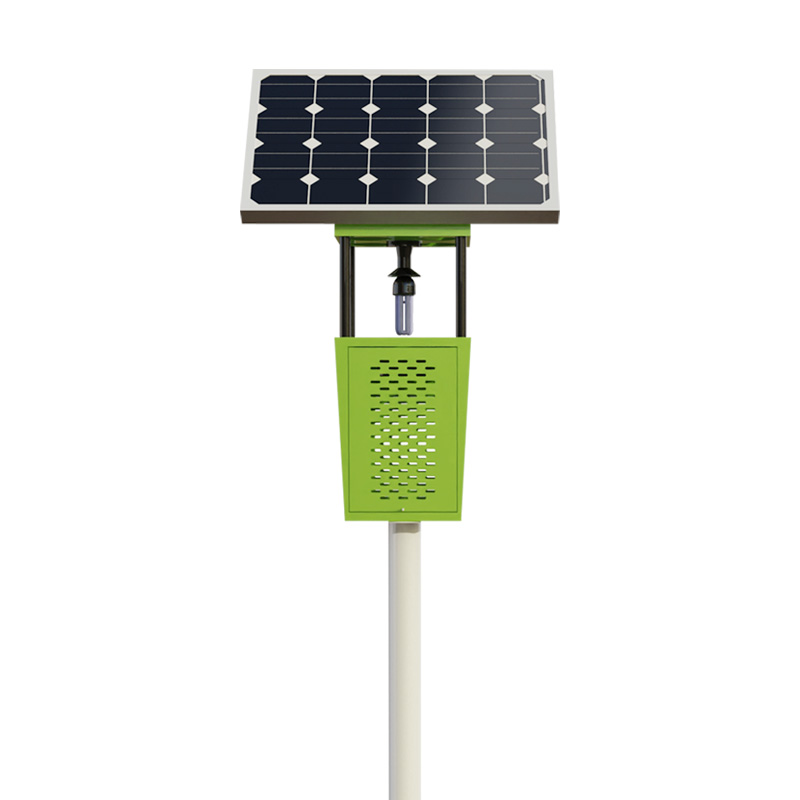
This lamp converts solar energy into electricity using a solar panel. At night, it powers an LED insect-attracting light source that releases specific wavelengths to attract phototactic pests. A fan generates negative pressure airflow, drawing the pests into a collection box where they are dried and dehydrated. This achieves effective physical pest control for insects of all sizes and is suitable for agriculture, forestry, horticulture, and warehousing.
The wind-suction solar-powered insecticidal lamp is a physical pest control device that uses solar energy as a power source, attracts pests with specific wavelengths of light, and uses a fan to generate negative pressure airflow to draw them into a collection container where they are dried and dehydrated. Combining light attraction and airflow suction technologies, it can kill insects of all sizes, effectively controlling pests and contributing to improved green pest control. Based on solar panels, the device stores power during the day and supplies power to the insecticidal lamp at night, attracting phototactic pests to the light source. Its insect-attracting wavelength range is typically set between 320nm and 680nm, covering the sensitive spectral range of various phototactic pests, including Lepidoptera and Coleoptera, achieving precise trapping. The wind-suction type insecticidal lamp can be widely used in agriculture, forestry and horticulture, animal husbandry, and urban and rural environmental sanitation, effectively improving pest control in farmland, vegetable gardens, and orchards.
Structurally, the wind-suction solar-powered insecticidal lamp consists of an insect-attracting light source, a fan system, an insect-collecting component, a solar power supply system, and supporting components. The core configuration includes a monocrystalline or polycrystalline silicon solar panel with a power output generally not less than 40W, paired with a safe and environmentally friendly lithium battery with a capacity typically above 20Ah. This combination achieves light energy conversion and storage, allowing continuous operation for 2 to 3 days even on cloudy or rainy days. The overall power consumption of the device is generally controlled below 20W. The insect-attracting lamp uses LED light sources, with power typically between 5 and 15W. The multi-band spectrum combination is beneficial for simultaneously trapping multiple types of pests. The fan uses a powerful spiral fan or high-powered fan; the negative pressure generated by the fan's rotation draws insects into the trap. The wind speed is no less than 4.0 m/s. The fan has an anti-jamming function, and the vortex wind tunnel device at the top of the fan can significantly increase the inlet wind speed under the condition of equal air outlet area. The fan is not contaminated or damaged by insect remains, reducing maintenance costs and extending its service life. The insect collection device uses a large-capacity removable mesh bag for easy disassembly and replacement. The collection device has an escape-proof structure and also includes an escape channel for beneficial insects to avoid accidental injury. The equipment is waterproof, with a protection rating of IP65 or higher, allowing normal operation in rainy weather.
Regarding operating modes, the wind-suction solar-powered insecticidal lamp is equipped with a dedicated solar controller, supporting light control, time control, rain control, and automatic charging/discharging protection functions. In light control mode, the device automatically turns off the lights during the day and turns them on at night, and can adaptively adjust according to sunrise and sunset times. In time control mode, it can automatically turn on the lights within a preset time period and turn them off outside of that period. In rain control mode, the rain sensor triggers the device to go into sleep mode, and it automatically resumes operation after the rain stops. Some network-connected models support 4G communication, allowing users to remotely control and monitor the devices via a mobile app or web interface, and view real-time information such as geographical location, light on/off status, device number, signal strength, and power consumption. One account can remotely control multiple devices with different numbers. The control radius of a single light is no less than 120m in farmland and no less than 80m in forest areas, with each light covering an area of approximately 15 to 50 acres (depending on local terrain, crops, and environmental conditions).
In an airport's operational system, visibility is one of the factors affecting aviation safety and efficiency. The installation of airport Visibility Sensors is precisely to monitor this critical meteorological data accurately and in real time, providing a scientific basis for aviation activitie...
The monitoring of negative oxygen ions in scenic areas is of great significance. On the one hand, negative oxygen ions are a direct manifestation of the ecological quality of scenic areas. A high concentration of them can purify the air, adsorb dust and germs. Tourists can relax their bodies and min...
The wind-suction solar insect trap consists of a solar panel, a storage battery, an intelligent controller, an LED insecticidal lamp, a wind-suction mechanism, and a collection bin. It stores electrical energy during the day and operates at night, utilizing negative airflow to draw pests into...
Ecological Environment Monitoring Station integrates BeiDou-3 regional short message communication technology with meteorological and environmental monitoring technology. This enables real-time observation of various meteorological parameters—including ultrasonic wind speed and direction, tem...