Shandong Fengtu IOT Technology Co., Ltd
Sales Manager:Ms. Emily Wang
Cel,Whatsapp,Wechat:+86 15898932201
Email:info@fengtutec.com
Add:No. 155 Optoelectronic Industry Accelerator, Gaoxin District, Weifang, Shandong, China


Sales Manager:Ms. Emily Wang
Cel,Whatsapp,Wechat:+86 15898932201
Email:info@fengtutec.com
Add:No. 155 Optoelectronic Industry Accelerator, Gaoxin District, Weifang, Shandong, China
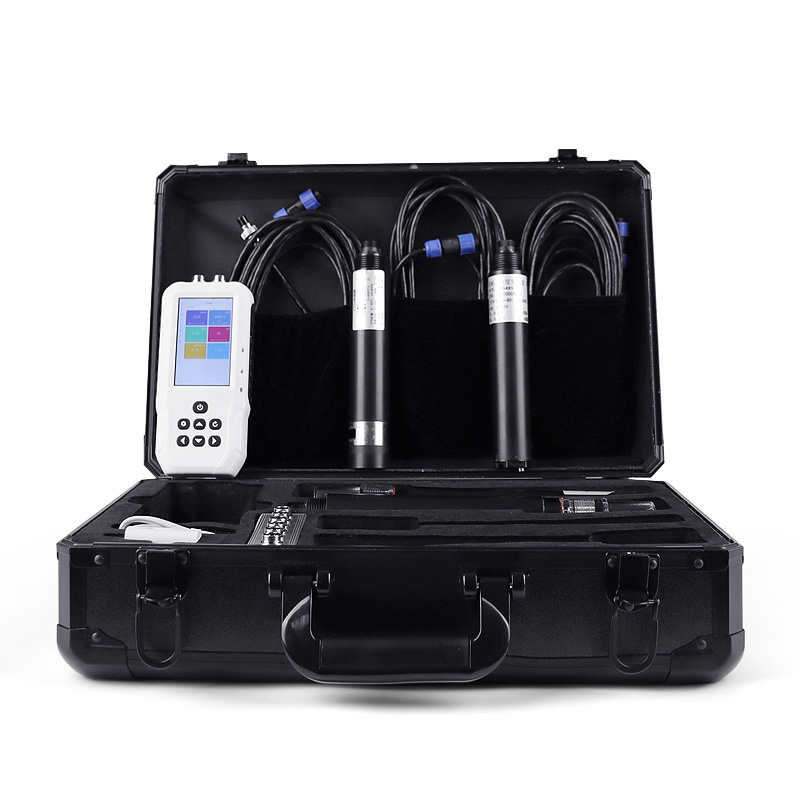
Model:FT-SS8
Brand:fengtu
1. Product introduction of Dissolved oxygen meter
SS8 model Dissolved oxygen meter is an electrode method water quality analysis instrument that uses fully digital electrode detection to detect dissolved oxygen parameters.The instrument is equipped with the self-developed ftiot operating system, which is simple to operate, has stable performance, accurate measurement, and wide detection range.It has a built-in high-capacity rechargeable lithium battery, making it convenient for users to conduct water quality testing at any time in the field or laboratory.
2.Dissolved oxygen meter host parameters
| Charging input voltage | 4.5V-5.5V |
| Charging current | <2A |
| screen size | 3.5 inches |
| screen resolution | 480*800☆ |
| screen interface | MIPI DSI☆ |
| USB interface | 2 (Supports external expansion of mouse, keyboard, 4G, etc.)☆ |
| Type-C | 1 (Supports external expansion of mouse, keyboard, 4G, etc.)☆ |
| RS485 | 2 (Supports Modbus, json, asc input, etc.) |
| External sensor supply voltage | 12V |
| External sensor supply current | 1A |
| operating system | ftiot (based on Linux-5.4)☆ |
| CPU | 2*Cotex-A7, 650Mhz☆ |
| RAM | 512M DDR3☆ |
| Flash | 8G-64G |
| OpenGL | ES 2.0☆ |
| Wifi | support |
| 4G | Optional |
| button | support |
| capacitive touch screen | support |
| software architecture | B/S☆ |
| web access | Support☆ |
| MTP mode | Support☆ |
| Multiple terminal login | Support☆ |
| IPV6 | Support☆ |
| Sensor communication method | RS485, TCP, UDP, HTTP☆ |
| Data forwarding method | RS485, TCP, UDP, HTTP☆ |
| Remote SSH | Support☆ |
| remote debugging | Support☆ |
3.Dissolved oxygen meter sensor parameters and configuration
| serial number | name | Measuring range | principle | Measurement accuracy | Configuration | Remark |
| 1 | temperature | 0~50℃ | High-precision digital sensor | ±0.3℃ | ||
| 2 | pH | 0~14(ph) | Electrochemistry (Salt Bridge) | ±0.1PH | ||
| 3 | ORP | -1500mv~1500mv | Electrochemistry (Salt Bridge) | ±6mv | ||
| 4 | Conductivity | 0~5000uS/cm,0~10000uS/cm | contact electrode method | ±1.5% | ||
| 5 | TDS | 0~20μS/cm (TDS 0-10mg/L) | contact electrode method | ±1.5% | ||
| 6 | salinity | 0-2.5ppt or 0-80ppt | contact electrode method | ±0.05ppt or ±1ppt | ||
| 7 | Sludge concentration | 0~20.000g/L | scattered light method | ±5% (depending on sludge homogeneity) | ||
| 8 | Turbidity | 0~40NTU (low turbidity) | scattered light method | ±1% | Optional | |
| 0~1000NTU (medium turbidity) | scattered light method | ±1% | ||||
| 0~3000NTU (high turbidity) | scattered light method | ±1% | ||||
| 9 | Dissolved oxygen | 0~20mg/L | fluorescence lifetime method | ±2% | ✔ | |
| 10 | Ammonia nitrogen | 0-1000.00mg/L (default) 0-100.00mg/l/ (customizable) | Ion selective electrode method | 10% of reading, ±0.5℃ | ||
| 11 | suspended solids | 0~2000mg/L | scattered light method | ±5% (depending on sludge homogeneity) | ||
| 12 | Residual chlorine | 0~5.00mg/L | Ion selective electrode method | ±5% of reading | The accuracy is best when the flow rate is 0.42m/s-0.85m/s. | |
| 13 | Chloride ions | 0-3500.0mg/L | Ion selective electrode method | ±5% | ||
| 14 | Total hardness | 0~1000.0mg/L | Ion selective electrode method | ±10% of reading | ||
| 15 | cod | 0~500mg/L | UV254 absorption method | ±5% | COD and chlorophyll are equipped with automatic cleaners to prevent biological adhesion and avoid light window pollution to ensure long-term monitoring is still stable; the automatic cleaning time and cleaning frequency can be set, and the power consumption is 0.7W | |
| 16 | Chlorophyll | 0~400ug/L | Fluorescence method | R2>0.999 |
Intelligent transportation utilizes new-generation information technologies such as the Internet of Things and cloud computing, along with theoretical tools like transportation science and artificial intelligence, aiming to achieve comprehensive perception and scientific decision-making. By building...
Low-visibility weather conditions (such as heavy fog, dense haze, heavy rain, and smoke/dust) reduce drivers' effective visual range and are a major cause of significant safety incidents including multi-vehicle rear-end collisions on highways and aircraft go-arounds or delays at airports. Theref...
In an era when the demand for meteorological information is increasing day by day, a variety of multi-functional weather stations have emerged on the market and have gradually become common devices in the field of meteorological monitoring. So here comes the question: why is it called a "multi-...
This article introduces two Portable Weather Stations: the Handheld Weather Station FT-SQ11 and the Portable Weather Station FT-BQX8 with a tripod.Handheld Weather Station FT-SQ11The FT-SQ11 is compact and lightweight, measuring 37020880mm and weighing only 363.2g for effortless portability. Its 3.5...


 Get a Free Quote
 Skype
Skype
 whatsapp
 mail
mail