Shandong Fengtu IOT Technology Co., Ltd
Sales Manager:Ms. Emily Wang
Cel,Whatsapp,Wechat:+86 15898932201
Email:info@fengtutec.com
Add:No. 155 Optoelectronic Industry Accelerator, Gaoxin District, Weifang, Shandong, China


Sales Manager:Ms. Emily Wang
Cel,Whatsapp,Wechat:+86 15898932201
Email:info@fengtutec.com
Add:No. 155 Optoelectronic Industry Accelerator, Gaoxin District, Weifang, Shandong, China
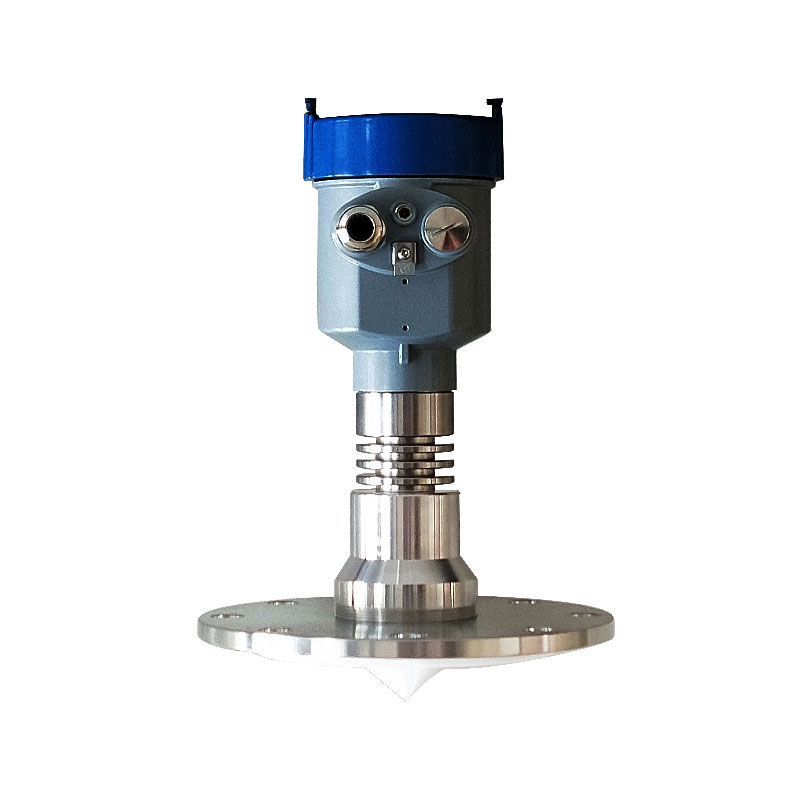
Model:YW-26B
Brand:fengtu
1.Product Principle of Corrosive Liquid Level Sensor
The radar level antenna emits a narrow microwave pulse, which is transmitted downward through the antenna. After the microwave contacts the surface of the measured medium, it is reflected back and received by the antenna system again, and the signal is transmitted to the electronic circuit part and automatically converted into a level signal (because the microwave propagation speed is extremely fast, the time taken for the electromagnetic wave to reach the target and return to the receiver through reflection is almost instantaneous).
2. Corrosive liquid level sensor technical parameters
Product features: PTFE cone antenna
Typical applications: liquids, powders, high-sanitation situations, situations prone to crystallization, condensation, and adhesion of oil smoke and dust, etc.
Measuring range: 30 meters
Antenna material: PTFE (optional)
Accuracy: ±5mm
Process temperature: -40~260℃
Process pressure: -0.1~4.0Mpa
Power supply: 24vDC (two-wire, four-wire)
Signal output: 4~20mA/Har (two-wire/four-wire)
RS485/Modbus
Process connection: flange (≥DN50 optional)
Protection level: IP67
Frequency range: 26GHz
Protection level: IP67
Explosion-proof grade: ExiaⅡC T6 Ga/Exd ia IIC T6 Gb
On-site display: LED (standard)
Cable entry: M20*1.5, ½NPT (optional)
Shell material: cast aluminum, 304 stainless steel (optional)
3. Features of Corrosive liquid level sensor
The antenna is small in size and easy to install; it is a non-contact radar, without wear and pollution.
Almost unaffected by corrosion and foam; almost unaffected by water vapor, temperature and pressure changes in the atmosphere.
Severe dust environment has little effect on the operation of high-frequency level meters.
The shorter the wavelength, the better the reflection from inclined solid surfaces.
The small beam angle and concentrated energy enhance the echo capability while helping to avoid interference.
The measurement blind area is smaller, and good results can be achieved even for small tank measurements.
High signal-to-noise ratio for better performance even under fluctuating conditions.
High frequency, the best choice for measuring solids and low dielectric constant media.
In the field of modern agriculture, with the popularization of precision agriculture and smart agriculture concepts, there is an increasing demand for quantitative management and scientific decision-making in agricultural production environments. Agrometeorological stations have emerged as automated...
Agricultural conditions refer to various situations presented by crops during their growth and development, encompassing multiple aspects such as soil fertility and moisture content of cultivated land, seedling conditions, growth trends, pest and disease situations of crops, as well as agricultural...
Tea garden insecticidal lamps is solar-powered and uses an insect-attracting light source to attract and kill pests. It is primarily used to trap and kill tea garden pests such as the tea green leafhopper, lepidopteran pests, leafhoppers, and inchworms. It is also suitable for pest control in...
What are the negative oxygen ion monitoring equipment? What is the role? In daily life, we often hear terms such as "negative oxygen ions". So what are these? Let's find out below!...


 Get a Free Quote
 Skype
Skype
 whatsapp
 mail
mail