Shandong Fengtu IOT Technology Co., Ltd
Sales Manager:Ms. Emily Wang
Cel,Whatsapp,Wechat:+86 15898932201
Email:info@fengtutec.com
Add:No. 155 Optoelectronic Industry Accelerator, Gaoxin District, Weifang, Shandong, China


Sales Manager:Ms. Emily Wang
Cel,Whatsapp,Wechat:+86 15898932201
Email:info@fengtutec.com
Add:No. 155 Optoelectronic Industry Accelerator, Gaoxin District, Weifang, Shandong, China
time:2025-07-08 09:21:22 source:Weather Station viewed:395 time
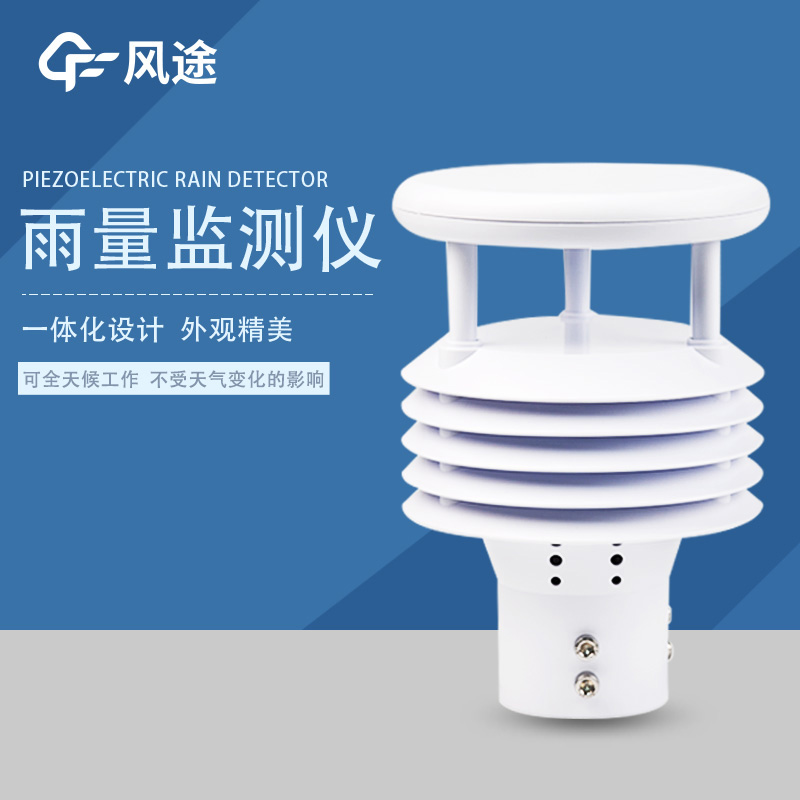
A rain gauge is an important device used to measure precipitation. With the continuous advancement of science and technology, the types of rain gauges have become increasingly diverse, among which the piezoelectric rain gauge has emerged as a "new favorite" in the market in recent years. Below, I will take Fengtu's rain gauge products as an example to compare the differences between piezoelectric rain gauges and other common rain gauges.
Comparison with Tipping Bucket Rain Gauges
The tipping bucket rain gauge is the most classic rain measurement device. It collects rainwater through an inclined funnel. When a certain amount of rainwater enters the funnel, the funnel tilts and dumps the water inside. At this time, the sensor detects this action, thereby recording a rainfall event. Fengtu's tipping bucket rain gauge has a maximum rainfall intensity measurement range of 4mm/min, an operating temperature generally between 0~50℃, and a measurement accuracy of ≤±3%.
This type of rain gauge has some drawbacks. Due to its mechanical structure, the flipping of the tipping bucket is prone to be affected by the friction of the rotating shaft, water or sediment sticking to the funnel, insects, etc., leading to measurement errors. During heavy rain, the inertia of the tipping bucket makes it unable to flip in time, resulting in the loss of rainwater and distorted data. Moreover, tipping bucket rain gauges require manual maintenance and have high requirements for the installation environment.
In contrast, Fengtu's piezoelectric rain gauge adopts piezoelectric ceramic kinetic rain monitoring technology, which identifies rainfall based on the force of raindrop impact. Its effective piezoelectric panel size is larger than φ200mm, and it can measure a maximum rainfall intensity of 8mm/min, which is twice the range of traditional rain gauges. The piezoelectric rain gauge can accurately monitor the duration of rainfall down to the second, and can also estimate the maximum impact on the ground and the diameter of raindrops, which the tipping bucket rain gauge cannot do. It integrates all components into a single housing with no exposed parts, eliminating the impact of debris such as leaves, dust, and insects on data accuracy. It also does not require on-site manual cleaning, is simple and quick to install, and has no special requirements for the installation environment.
In canal shipping, visibility is a key factor affecting the safety of ship navigation. Weather conditions such as fog, haze, rain, and snow can reduce visibility on canals, making it difficult for ship drivers to clearly identify waterways, navigation marks, and other ships, increasing the risk of a...
Accurate monitoring of road conditions is conducive to ensuring traffic safety and improving road operation efficiency. Traditional road monitoring methods have limitations, and the emergence of Road Condition Monitor has brought us new solutions.One of the major advantages of Road Condition Monitor...
The automatic monitoring station of ambient air quality can conduct real-time online monitoring of pollution factors in the air, and can provide data feedback through a large screen or display data through the user data statistics port. The monitoring items include the four gases and two dusts inclu...
Soil moisture monitoring system can continuously monitor soil moisture for a long time. Users can install soil moisture sensors at different locations and depths according to their needs. The system also supports the addition of other sensors for measuring soil temperature, conductivity, pH, as well...


 Skype
Skype
 whatsapp
 mail
mail