Shandong Fengtu IOT Technology Co., Ltd
Sales Manager:Ms. Emily Wang
Cel,Whatsapp,Wechat:+86 15898932201
Email:info@fengtutec.com
Add:No. 155 Optoelectronic Industry Accelerator, Gaoxin District, Weifang, Shandong, China


Sales Manager:Ms. Emily Wang
Cel,Whatsapp,Wechat:+86 15898932201
Email:info@fengtutec.com
Add:No. 155 Optoelectronic Industry Accelerator, Gaoxin District, Weifang, Shandong, China
time:2026-05-20 11:40:44 source:Weather Station viewed:14 time
The transmission line micro-meteorological online monitoring system is an industrial-grade meteorological monitoring device installed on power transmission towers. It uses a high-precision sensor array to collect meteorological parameters such as wind speed, wind direction, temperature, humidity, air pressure, and rainfall in real time. The data is wirelessly transmitted to a monitoring center via GPRS or fiber optics for intelligent analysis. When meteorological parameters exceed preset thresholds, it sends early warning SMS messages to maintenance personnel. It is suitable for mountainous areas, canyons, and other areas traditionally lacking meteorological monitoring capabilities.
Transmission lines are widely distributed in complex terrain areas such as mountains, canyons, and rivers. Their safe operation is directly affected by local micro-meteorological changes. Traditional weather stations are generally spaced more than 10 kilometers apart, making it difficult to capture small-scale meteorological changes within transmission corridors, resulting in significant delays in early warnings of disasters such as icing and strong winds. The transmission line micro-meteorological online monitoring system is an industrial-grade multi-element monitoring device designed to address this problem. Through a sensor array installed on the power transmission towers, it achieves accurate perception of the local meteorological environment along the transmission line corridor.
The transmission line micro-meteorological online monitoring system consists of three parts: a meteorological sensor array, a control terminal, and a communication module. Sensors typically include temperature, humidity, wind speed, wind direction, rainfall, and barometric pressure sensors, deployed on transmission towers to collect meteorological data in real time. The control terminal receives sensor signals and transmits the monitoring information to a remote monitoring center via GPRS, 4G, fiber optics, etc. In terms of technical specifications, the system's temperature measurement range covers -40°C to 85°C with an accuracy of ±0.2°C; humidity measurement ranges from 0 to 100% relative humidity with an accuracy of ±2%; wind speed measurement ranges from 0 to 75 meters per second; and wind direction measurement covers an omnidirectional range of 0 to 360 degrees. The overall equipment protection level reaches IP66 or higher, enabling continuous and stable operation under harsh climatic conditions such as extreme cold, high temperature, and high humidity.
The power supply system is crucial for ensuring the long-term operation of the equipment in the field. The system uses solar panels in conjunction with a battery bank, allowing it to operate for more than 30 days without sunlight. Some models also integrate a multi-mode complementary power supply system combining photovoltaic, wind power, and energy storage, maintaining stable operation within an ambient temperature range of -20°C to 50°C. In terms of communication, the system supports multiple transmission methods, including 4G, 5G public networks, and dedicated power wireless networks, with data transmission latency controlled to within 10 seconds.
The data acquisition front end digitizes meteorological parameters and transmits them in real-time to the monitoring center via a wireless network. The monitoring center stores, displays, and intelligently analyzes the received meteorological information, generating reports, curves, statistical charts, and other visualized data. When monitored meteorological parameters such as wind speed and rainfall exceed preset thresholds, the system automatically triggers a multi-level early warning mechanism, sending warning information to designated personnel's mobile phones via SMS, audible and visual alarms, etc. Taking the system deployed by the Baiyin Power Supply Company in Gansu Province as an example, during a cold air outbreak in January 2025, the device issued a warning to maintenance personnel 40 minutes in advance, helping staff accurately identify high-risk sections and deploy defenses in advance, successfully avoiding the risks of conductor wind-induced flashover and phase-to-phase collision short circuits.
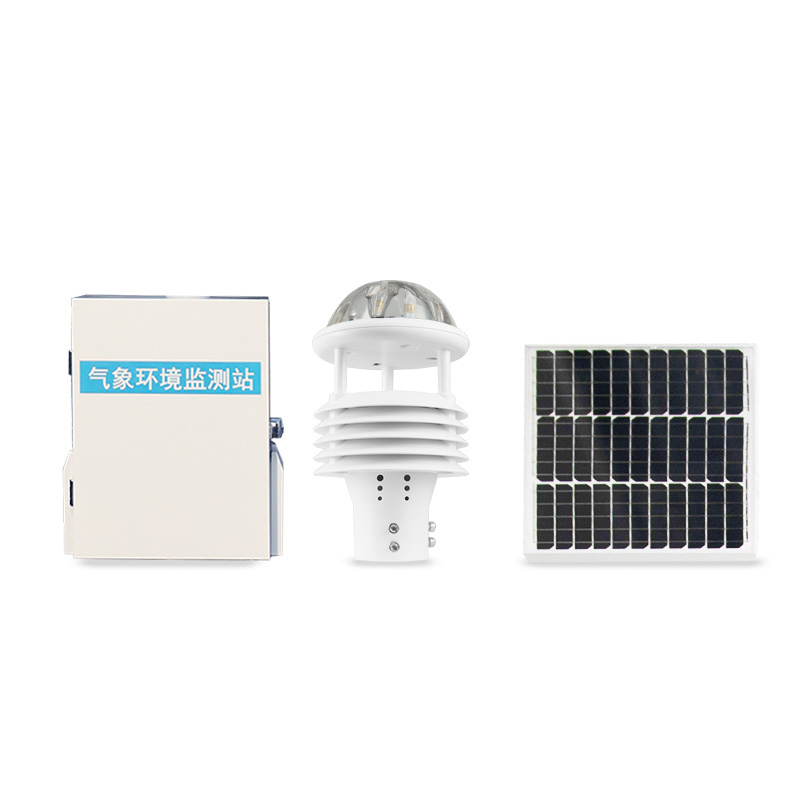
This fully digital electric field detection and warning platform employs MEMS technology at its core. The electric field measurement range is -100kV/m to 100kV/m, with a resolution of 0.1V/m and a detection radius of 15km. The system acquires electric field changes through the principle of cha...
During the current highway construction period, in accordance with design requirements, road meteorological stations and atmospheric visibility meters have been installed on most road sections. Among them, road meteorological stations are mainly used to collect environmental meteorological informati...
In traditional visibility observation, meteorological personnel determine the visibility by judging the furthest visible and the nearest invisible target objects. A target object distribution map is drawn in an area with a wide view around the meteorological station. Target objects of moderate size,...
A Portable Weather Station for firefighting is a lightweight and multi-functional weather monitoring device specially designed for fire rescue scenarios. It is mainly used to monitor the meteorological conditions at the fire scene in real-time, helping firefighters assess the development trend of th...


 Skype
Skype
 whatsapp
 mail
mail