Shandong Fengtu IOT Technology Co., Ltd
Sales Manager:Ms. Emily Wang
Cel,Whatsapp,Wechat:+86 15898932201
Email:info@fengtutec.com
Add:No. 155 Optoelectronic Industry Accelerator, Gaoxin District, Weifang, Shandong, China


Sales Manager:Ms. Emily Wang
Cel,Whatsapp,Wechat:+86 15898932201
Email:info@fengtutec.com
Add:No. 155 Optoelectronic Industry Accelerator, Gaoxin District, Weifang, Shandong, China
time:2025-09-28 09:50:49 source:Weather Station viewed:432 time
The development of Portable Weather Stations stems from the need for rapid, flexible, and temporary meteorological observations, applied in fields such as emergency disaster reduction, scientific expeditions, and military support to compensate for the shortcomings of fixed stations.
Real-time meteorological data is needed at the scene of sudden natural disasters (such as typhoons, heavy rains, flash floods) to support rescue decision-making, but fixed stations may be damaged or located far from disaster areas. Moreover, battlefield environments, temporary bases, or military exercise areas require rapidly deployable and independent meteorological support systems.
Weather support for large-scale events (such as the Olympic Games, air shows), on-site monitoring of major engineering projects, and intensive urban meteorological observations also require temporarily deployed observation points.
Based on these needs and with advancements in sensor technology, data acquisition units, communication technology, and power supply technology, the market has launched Portable Weather Stations.
This is a highly integrated, rapidly deployable mobile observation system capable of automatically completing meteorological element observation and data transmission.
The entire system (including sensors, data acquisition unit, power supply unit, and mounting bracket) can be packed into a transport case, allowing single-person carrying and transportation.
Through simple tripods or lightweight towers, setup and activation can be completed within a short time (usually tens of minutes), immediately starting operation.
Unlike large automatic stations that use discrete sensors, portable stations typically highly integrate the measurement functions of multiple meteorological elements into a single or a few physical units.
This is the mainstream design. A compact sensor probe internally integrates chips for measuring temperature, humidity, and atmospheric pressure, and often simultaneously incorporates an ultrasonic wind speed and direction measurement unit. This design greatly reduces the number of external connections and independent probes, and avoids the cumbersome nature of multiple independent sensors and brackets, making the entire station more compact.
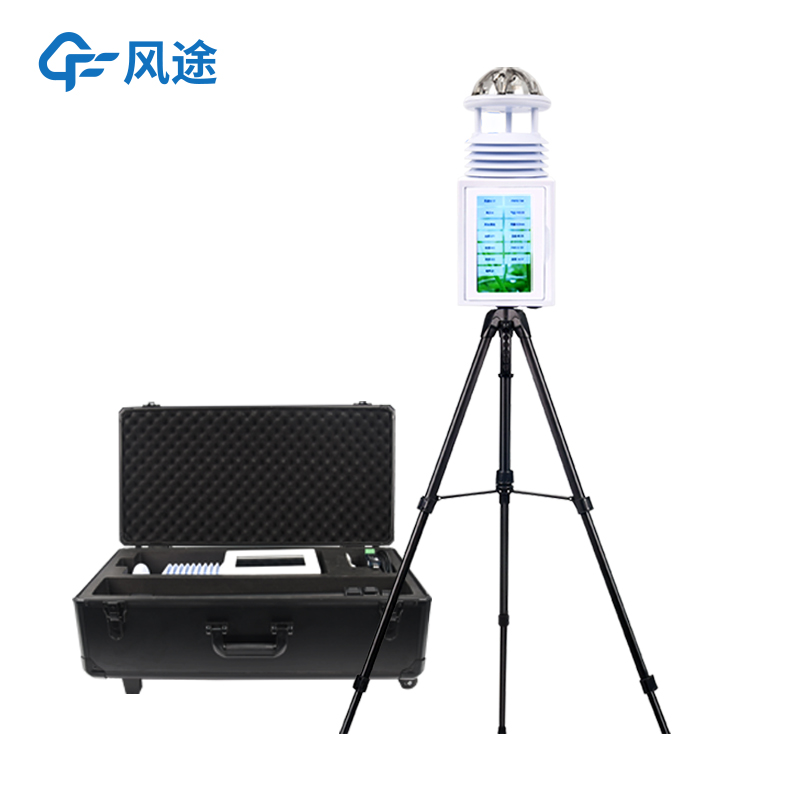
Meteorological emergency monitoring is an action that utilizes professional equipment and technologies to collect meteorological data in real-time and dynamically in response to sudden meteorological disasters or abnormal meteorological conditions. Through the rapid monitoring and analysis of meteor...
When driving in a tunnel, visibility monitoring is extremely crucial. The interior of a tunnel is relatively enclosed with limited air exchange and is prone to being affected by various factors that can reduce visibility. Such situations as bad weather, the accumulation of vehicle exhaust fumes, and...
A rain gauge is an important device used to measure precipitation. With the continuous advancement of science and technology, the types of rain gauges have become increasingly diverse, among which the piezoelectric rain gauge has emerged as a "new favorite" in the market in recent years. B...
Underwater Night Vision Goggle utilizes a high-performance third-generation image intensifier and is an electro-optical device specifically designed for observation and search in low-light or no-light underwater environments. It can effectively penetrate dark environments and accurately capture underwater details. Its main applications include underwater rescue in fire and emergency situations, underwater reconnaissance by armed police forces, underwater facility inspection for power companies, forest fire water source exploration, underwater evidence searching for police and public security, and underwater ecological monitoring for forestry and environmental protection....


 Skype
Skype
 whatsapp
 mail
mail