Shandong Fengtu IOT Technology Co., Ltd
Sales Manager:Ms. Emily Wang
Cel,Whatsapp,Wechat:+86 15898932201
Email:info@fengtutec.com
Add:No. 155 Optoelectronic Industry Accelerator, Gaoxin District, Weifang, Shandong, China


Sales Manager:Ms. Emily Wang
Cel,Whatsapp,Wechat:+86 15898932201
Email:info@fengtutec.com
Add:No. 155 Optoelectronic Industry Accelerator, Gaoxin District, Weifang, Shandong, China
time:2026-04-23 10:59:01 source:Weather Station viewed:159 time
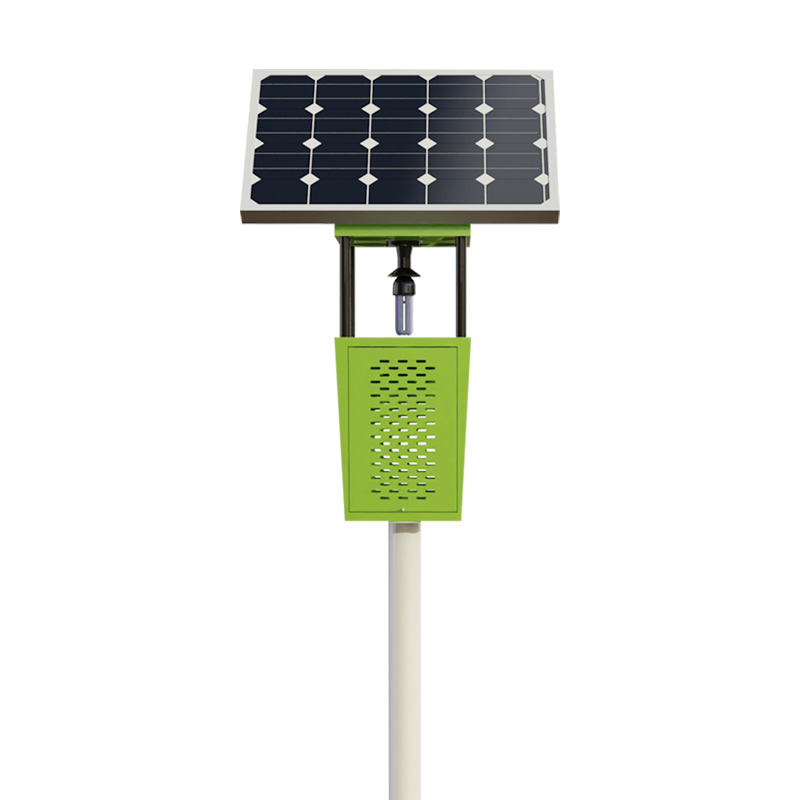
Tea garden insect traps utilize solar power and a wind-suction mechanism. By employing LED light sources of specific wavelengths, they lure pests to fly toward the device; a fan then generates a negative-pressure airflow that draws the pests into a collector, where they are desiccated through air-drying. This equipment is capable of luring and eliminating major pests—such as the tea green leafhopper, tea looper, and tea caterpillar—while simultaneously minimizing the accidental killing of beneficial natural enemy insects.
The tea garden insect trap is a physical control device specifically designed for the eco-friendly management of pests and diseases in tea plantations. Its primary objective is to lure and eliminate major tea garden pests, including the tea green leafhopper, tea looper, tea caterpillar, and tea tussock moth. Powered by solar energy, the device comprises several modules: a solar panel, a rechargeable battery, a pest-luring light source, a fan, a pest collector, and a mounting pole. It operates autonomously without the need for an external power supply. Its working principle relies on the phototactic behavior of pests: a specialized LED light source emitting specific wavelengths is used to lure adult pests at close range, while electromagnetic waves within specific bands provide long-range attraction. Once the pests approach the light source, the fan activates to generate a negative-pressure airflow, drawing them into the collector where they undergo desiccation through air-drying, thereby achieving the objective of pest elimination.
Tea garden insect traps offer significant advantages in terms of precision pest control. Traditional frequency-vibration electric-grid insect traps suffer from inherent flaws, such as low capture rates for small-bodied pests and high rates of accidental killing among natural enemies. In contrast, these specialized tea garden insect traps employ custom-designed LED light sources that concentrate their emission spectrum within the specific phototactic range of major tea pests. By carefully avoiding the phototactic spectrum of the dominant natural enemies found in tea gardens, the devices significantly reduce the accidental killing of beneficial insects such as lacewings and ladybugs. Experimental data from the Tea Research Institute of the Chinese Academy of Agricultural Sciences demonstrates that, compared to conventional frequency-vibration electric-grid traps, these "natural-enemy-friendly" LED insect traps increase the capture rate of major tea pests by 55% to 85%, while simultaneously reducing the accidental killing of natural enemies by 70% to 89%. This insecticidal lamp boasts an effective control range of up to 65 meters against the tea green leafhopper and up to 100 meters against geometrid moths; a single unit can effectively manage a tea garden area ranging from 15 to 50 *mu*.
In practice, these tea garden insecticidal lamps have been widely adopted across numerous major tea-growing regions throughout the country. To date, Top Cloud-Agri alone has deployed approximately 13,000 narrow-spectrum LED insecticidal lamps in tea gardens across 19 provinces, including Zhejiang, Fujian, Guangdong, Jiangxi, Hunan, and Hubei. In the 3,500-*mu* ecological tea garden demonstration zone in Huangtun Village, Songxi County, Fujian, 50 solar-powered insect-luring lamps were installed. Each lamp covers an effective insect-control area of 15 to 20 *mu*; by utilizing a physical trapping method to effectively reduce pest populations, the system safeguards both the quality and safety of the tea leaves and the ecological balance of the tea garden. In Lianhua Town, Tongan District, Xiamen, 480 wind-suction insecticidal lamps are distributed across 7,400 *mu* of tea gardens; local tea farmers have reported a marked increase in pest control efficiency, ease of equipment maintenance, and improvements in both tea quality and yield.
The economic and ecological benefits of utilizing these tea garden insecticidal lamps are equally significant. By reducing the reliance on chemical pesticides—with the demonstration zones achieving an average reduction of 70%—the system ensures "zero detection" of highly toxic pesticide residues in the tea leaves, thereby fundamentally resolving the residue-related issues associated with chemical pesticide use. For a single crop season, pesticide applications can be reduced by 4 to 5 rounds, lowering pest control costs by over 100 RMB per *mu* while simultaneously establishing an ecological循环 chain: "physical pest control → poultry feed → organic fertilizer." The equipment supports light-sensing, timer-based, and rain-sensing control modes, allowing for automatic activation at dusk, automatic deactivation at dawn, and automatic power-off protection during rainy weather. Furthermore, the networked version allows users to remotely monitor the device's operational status and power consumption via a mobile app, eliminating the need for manual on-site supervision.
Traditional fixed visibility monitoring equipment is limited by factors such as installation location and power supply conditions, making it difficult to meet flexible and variable monitoring needs. The emergence of the Portable Visibility Detector has effectively solved this problem.Low visibility...
As an important part of the power system, the safe operation of the transmission line directly affects the social and economic development. Therefore, in the actual production, it is necessary to do a good job in the maintenance of the transmission line to ensure that the transmission line has good...
For a long time, agricultural production has largely relied on experience and the observation of the weather. When it comes to sowing, irrigation and dealing with extreme weather conditions, decisions often depend on traditional wisdom passed down orally. Nowadays, agricultural meteorological statio...
Plant Growth Monitoring System comprehensively utilizes Internet of Things (IoT), cloud computing, and video streaming technologies to collect real-time video images of crop growth, pests, diseases, and disasters through field monitoring equipment. Combined with meteorological and soil moisture data, it provides visual monitoring and management decision support for agricultural planting....


 Skype
Skype
 whatsapp
 mail
mail