Shandong Fengtu IOT Technology Co., Ltd
Sales Manager:Ms. Emily Wang
Cel,Whatsapp,Wechat:+86 15898932201
Email:info@fengtutec.com
Add:No. 155 Optoelectronic Industry Accelerator, Gaoxin District, Weifang, Shandong, China


Sales Manager:Ms. Emily Wang
Cel,Whatsapp,Wechat:+86 15898932201
Email:info@fengtutec.com
Add:No. 155 Optoelectronic Industry Accelerator, Gaoxin District, Weifang, Shandong, China
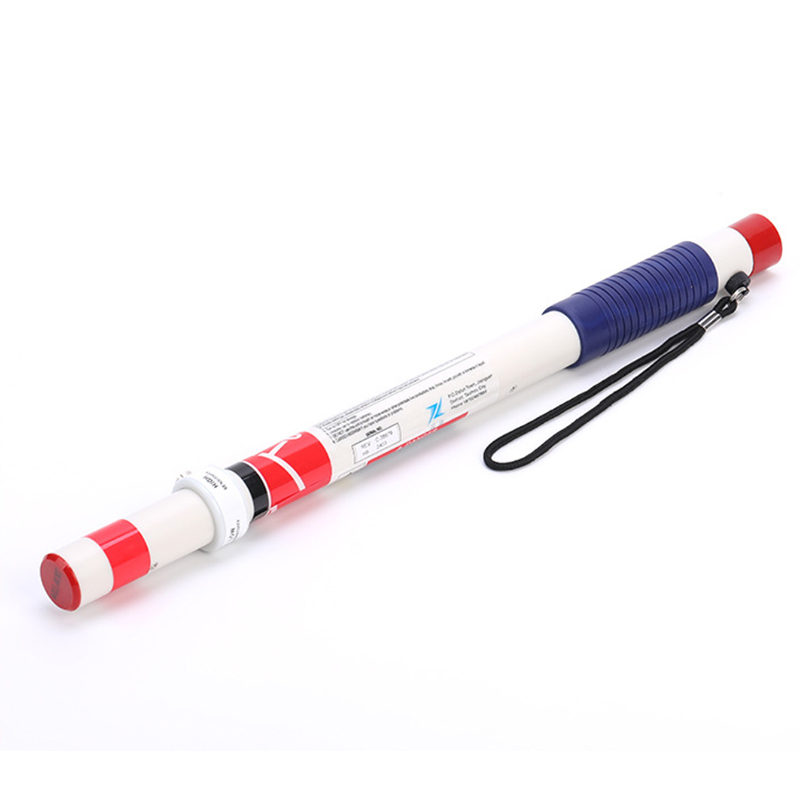
Model:FT-LDB1
Brand:fengtu
1、Equipment Leakage Current Tester technical Specifications:
1.Detection Voltage: 120V/60Hz or 220V/50Hz; 7.2kV/50Hz or 15kV/50Hz;
2.Continuous Use Time: 300 hours;
3.Operating Temperature: -30℃~50℃;
4.Sensitivity: 3 sensitivity level settings;
5.Dimensions: Diameter 45mm × Length 530mm (±5%);
6.Detection Capability: When near a 220V voltage source, set to high sensitivity mode, it can detect the voltage and emit an alarm at a distance of 10cm from the 220V voltage source;
7.Weight: 430g (±5%).
2、Equipment Leakage Current Tester scope of application:
Used for detecting live or leaking electrical equipment during emergency rescue operations.
3、Equipment Leakage Current Tester instructions for use:
Insert your arm through the smooth strap of the detector; the red striped area is the sensing part.
To turn on the device: Rotate the mode switch ring to the high sensitivity setting.
Self-test: After setting to the high sensitivity setting, wait for the self-test cycle to complete (at least three seconds). A beeping sound and flashing light will indicate completion.
4、Equipment Leakage Current Tester note
Stop using the device if there is no beeping sound, flashing light, or "chirping" sound after self-testing.Troubleshoot according to the instructions.
If the self-test is interrupted, slowly move the detector back and forth.
Continue using the high sensitivity setting until the approximate location of the AC voltage is determined.
A beeping sound and LED display will occur when the detector is near AC power.
The beeping sound and LED display will accelerate when the sensing part is close to the power source.Occasional beeping may occur when surrounded by AC power; this is normal when the detector is moving and is caused by static charges from other areas.
The higher the detector is placed, the easier it is to detect the power source.
Once the AC source is clearly detected, quickly switch to the low sensitivity setting or the medium sensitivity setting to pinpoint the power source.Do not touch conductors or place in liquids.
Besides the switch setting, many factors affect the first signal indication of dangerous AC voltage.Detection sensitivity depends on the following factors:
(1) If the AC signal is completely shielded by grounded metal, the detector will not be able to detect it.Metal doors and metal sheets will block the radiation of the AC magnetic field.The detector will also sense if the metal object is connected to or very close to the AC signal source.Some shielding materials such as wet leaves and trees will also reduce the range, so the detector may give a remote alarm when there are trees or puddles near the AC source.
(2) The height of the detector from the ground and the height of the signal source will affect the distance between the AC source and the first alarm.The higher the detector is from the ground, the wider its detection range.Placing it on the ground will severely limit its detection range.This is the same as the placement of electrical wires.
(3) The higher the AC signal source, the easier it is to detect.
(4) The physical size of the conductor also affects the distance of the first alarm.A car is easier to detect than a small piece of wire as an AC source.
Note: Please select the high sensitivity setting when starting work.
Position Assessment: Hold the end of the lanyard and move in different directions, observing the LED display.If a signal is displayed, stop moving.If the signal continues to alarm, try to find the source of the signal.The stronger the signal and the faster the beeping frequency, the closer the detector is to the AC source.Reduce sensitivity or switch to a lower range setting to pinpoint the source.
B.Vehicle Accidents: When a vehicle strikes an electrode, transformer, building, traffic light, or other device, use the detector to check if the vehicle, wires, fences, or surrounding materials are energized.
C.Swimming Pools: When lighting equipment or other electrical devices fall into a swimming pool, it usually causes the pool to become electrically conductive.Before rescuing victims, use the detector to determine if the swimming pool is dangerous.
D.Night Search: During nighttime searches, especially on nights with strong winds and hail, some trees or power lines may be energized.Use the detector to determine if there are any electrical hazards in the search and rescue area.
E.Collapsed Buildings: Buildings after explosions, earthquakes, or storms may be connected to underground cables or secondary circuits.Use the detector to determine if rescue work is safe.
F.Fires: In case of fire, use the detector to confirm whether there are any live wires or high-voltage lines posing a danger.
G.Cleanup Work: When rescue workers are performing cleanup work, they face the risk of electrical leakage from emergency rescue auxiliary power generation equipment.The detector can be used to check the power generation equipment.
5、Equipment Leakage Current Tester replacing the Battery:
Choose a safe, dry, and clean location.
Place the detector flat on a table.
Loosen the knurled retaining screw; the spring-loaded gray back cover containing the buzzer will be pushed out.
Pay attention to the polarity and installation of the batteries.
The four battery contacts near the positive terminal of the battery pack are connected to the buzzer.
Lift the front of the detector to allow the batteries to slide out.
Place the detector flat again to allow the new batteries to slide in.
Carefully replace the back cover, ensuring the retaining screw aligns with the hole in the casing.
Hold the detector upright, carefully close the back cover, and tighten the retaining screw.
Test the device.If the self-test fails, recheck the battery installation for correctness.
6、Equipment Leakage Current Tester precautions:
(1) Exercise caution when performing voltage detection, and take appropriate measures after measurement.
(2) This device does not provide a hazard warning for direct current.
(3) Shielded AC voltage cannot be detected.Exercise caution when using this device in areas with multiple circuits, especially when using low sensitivity or pre-focused settings.Do not neglect other sources when precisely operating on one source.
(4) When the pre-focus setting is enabled, the detector will receive a signal from the end-of-test prompt.Do not use this setting or low sensitivity settings at the beginning.The detector's sensitivity will decrease or it will no longer receive signals from other directions.Be careful not to accidentally touch undetected conductive wires.
(5) Always exercise caution with automatic testing.Use the detector to test whether barbed wire or conductive wires are truly safe.(6) Do not touch water or surrounding pools if you are unsure whether there is a hazard.
(7) Even if the power lines are disconnected, always use the detector to verify.Emergency power generators or alternative power sources can also cause voltage to be present at the user's location; 120 volts through overhead lines in a secondary circuit can produce 7200V.
(8) Clean the detector with soapy water.The area near the buzzer cover is not waterproof; be careful not to let water enter during cleaning.
(9) This product does not include batteries; batteries must be purchased separately.
Field Microclimate Monitor is a monitoring device specifically designed for agriculture. It enables real-time monitoring of microclimate conditions within agricultural fields—including data on temperature, humidity, and light intensity—and features a highly integrated, low-power design that...
Atmospheric visibility refers to the maximum horizontal ground distance at which a person with normal vision can clearly see the outline of a target under current weather conditions. As a crucial basis for judging atmospheric environmental conditions, it directly influences our assessments of atmosp...
Visibility data is crucial for the safe conduct of various activities, and the Environment Visibility Sensor is the "hardcore player" that can shoulder this responsibility.In terms of protection, its housing is made of high-quality aluminum material, treated with anodizing and painting, fu...
The Portable Weather Station is a meteorological device specifically designed for emergency rescue sites. It features a simple design and is equipped with a shock-absorbing trolley case, which enables it to be easily carried to various rescue sites and quickly deployed within a short period of time,...


 Get a Free Quote
 Skype
Skype
 whatsapp
 mail
mail