Shandong Fengtu IOT Technology Co., Ltd
Sales Manager:Ms. Emily Wang
Cel,Whatsapp,Wechat:+86 15898932201
Email:info@fengtutec.com
Add:No. 155 Optoelectronic Industry Accelerator, Gaoxin District, Weifang, Shandong, China


Sales Manager:Ms. Emily Wang
Cel,Whatsapp,Wechat:+86 15898932201
Email:info@fengtutec.com
Add:No. 155 Optoelectronic Industry Accelerator, Gaoxin District, Weifang, Shandong, China
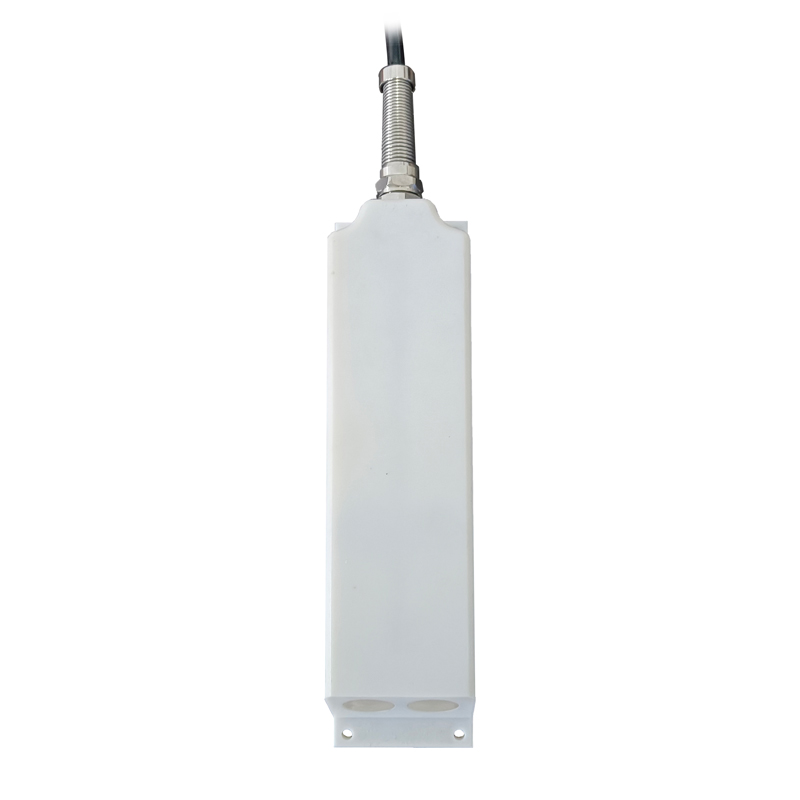
Model:FT-L1S1
Brand:fengtu
1.Doppler Flow Meter Product Principle
Doppler Flow Meter uses the physics principle of Doppler frequency shift to measure water flow speed, and is used for online flow measurement in rivers or open channels.In the field of acoustics, when there is relative motion between the sound source and the receiver (i.e., the probe and the reflector), the frequency of the echo will change. This change in frequency is called frequency shift, or the Doppler effect. The frequency of the sound wave becomes higher when it moves toward the observer and lower when it moves away from the observer. The Doppler Flow Meter calculates the flow velocity by calculating the frequency change.
2. Doppler Flow Meter Technical Parameters
1. Power supply: DC10-15V
2. Working current: 80-180mA 12V
3. Sound wave frequency: 2MHZ
4. Blind area: 6.5-7 cm (the water level is lower than the blind area and the measurement data accuracy is low)
5. Flow rate range: 0m~+6m/s,
6. Accuracy: ±1.0%±1cm/s
7. Water level: Range: 0.03m~5m (10m can be customized), Accuracy: 0.3%±0.5cm
8. Water temperature: Range: -10℃~60℃, Accuracy: ±1℃
9. Instantaneous flow range: 0~99.99m³/s
10. Cumulative flow range: 0.1m³~999999m³
3. Doppler Flow Meter Installation Instructions
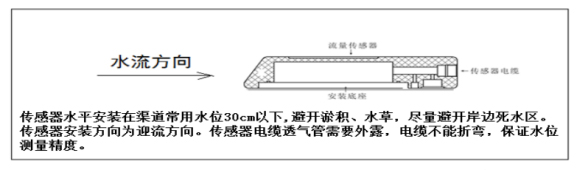
Normal installation ensures that it is 20CM below the lowest water level to avoid exposure to water.
Sensor installation instructions:
IV. Doppler Flow Meter Notes
1. The sensor needs to be kept away from silt, stones and other objects. A grille needs to be installed in places with a lot of aquatic plants to prevent entanglement.
2.Sensor installation direction: the sensor emitting surface needs to be installed in the flow direction.
3. The sensor has an acoustic blind spot. Try to keep the sensor below 20 cm underwater (false data may occur if the sensor is half exposed underwater or blocked by mud. The probability is very low. Usually the data will be large, such as more than 2 meters/second. It is recommended that the secondary developer of the sensor can shield large flow rate values by the water level, or in actual application scenarios, the water flow rate is not that large and the flow rate greater than 2 meters can be directly shielded).
4. The cable vent pipe is easily broken, which will affect the water level measurement.
5. Try to do a good job of lightning protection for signals and power supplies.
6. If the sensor cable is extended, a 485 relay is required and the power supply should avoid interference from the inverter.
Handheld Weather Stations need continuous upgrades to better meet diverse meteorological monitoring needs. The FT-SQ6+ has been upgraded in multiple aspects compared to its predecessor, the FT-SQ5.First, it offers a richer set of measurement parameters. The FT-SQ6+ adds measurements of average wind...
Microclimate refers to the special climate formed in the atmosphere of a local area, which is different from the macroclimate, due to differences in underlying surface factors such as surface properties, terrain, and vegetation. Compared with the macroclimate, the microclimate is closer to human pro...
The Portable Weather Station and the Vehicle-Mount Weather Station are significantly different in multiple aspects and are different products that meet the needs of meteorological monitoring in various scenarios.The Portable Weather Station focuses on flexibility and portability. It is applicable to...
This shore-based micro weather sensor is equipped with a 6-in-1 integrated sensor, enabling accurate simultaneous measurement of six meteorological parameters: wind speed, wind direction, atmospheric pressure, temperature, humidity, and optical rainfall.Ultrasonic technology is used for wind speed a...


 Get a Free Quote
 Skype
Skype
 whatsapp
 mail
mail