Shandong Fengtu IOT Technology Co., Ltd
Sales Manager:Ms. Emily Wang
Cel,Whatsapp,Wechat:+86 15898932201
Email:info@fengtutec.com
Add:No. 155 Optoelectronic Industry Accelerator, Gaoxin District, Weifang, Shandong, China


Sales Manager:Ms. Emily Wang
Cel,Whatsapp,Wechat:+86 15898932201
Email:info@fengtutec.com
Add:No. 155 Optoelectronic Industry Accelerator, Gaoxin District, Weifang, Shandong, China
time:2025-03-26 08:55:37 source:Weather Station viewed:479 time
In the field of road traffic, adverse weather conditions are like invisible "traffic killers", posing a huge threat to safe operations. Road surface water accumulation, thick snow, excessive rain and snowfall, or the frequent occurrence of extreme weather such as dense fog, thick fog, sandstorms, rainstorms, blizzards, as well as reduced visibility caused by smoke pollution, coupled with factors such as excessive vehicle speeds and heavy traffic volumes, have exponentially increased the risk of traffic accidents.
According to authoritative data, on highways, traffic accidents caused by dense fog and icy, slippery conditions account for approximately 25% of the total number of accidents. At night, due to a further reduction in visibility, the traffic accident rate is 1 to 1.5 times higher than during the day. Under adverse weather conditions, the accident rate on highways is 10 times that of normal conditions. Behind these astonishing figures are the loss of countless lives and the fragmentation of families, which also makes us deeply aware that it is urgent to improve the level of road traffic safety and strengthen traffic management in adverse weather.
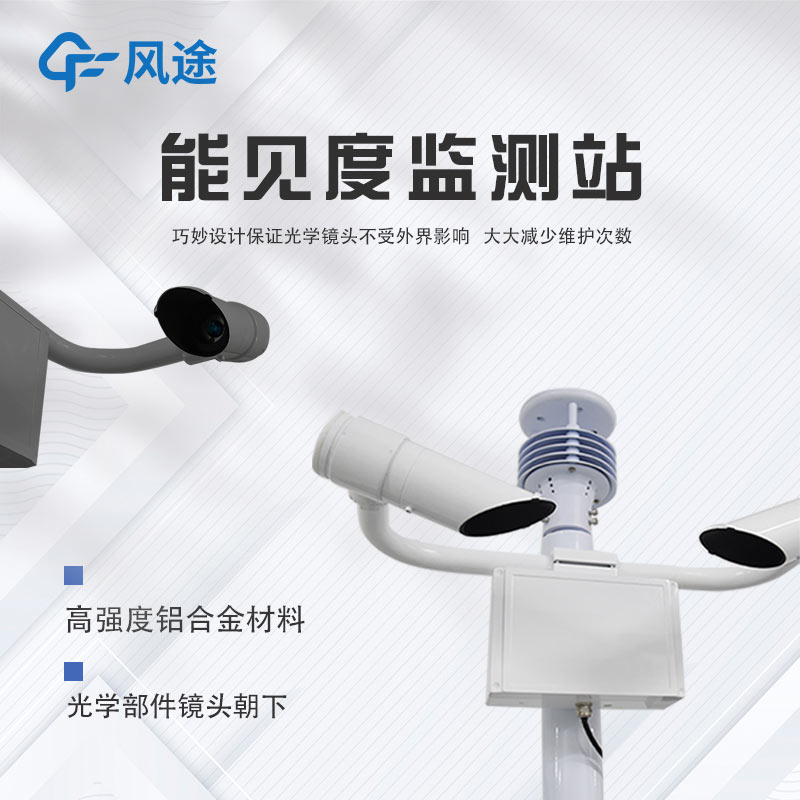
In order to standardize, standardize and intelligentize the handling of traffic risks in adverse weather on specific road sections, and to minimize the negative impact of adverse weather on road traffic safety, the visibility sensor, as a professional atmospheric visibility monitoring device, has emerged. It plays an irreplaceable and important role in the fields of environmental protection and traffic safety. This project focuses on planning and building an efficient and accurate Visibility monitoring station, providing strong support for traffic management departments through advanced technological means, and comprehensively safeguarding road traffic safety.
When low visibility meteorological phenomena occur, various monitoring modules at the front end of the system, especially the meteorological visibility sensor, will be quickly activated to collect and analyze the on-site environmental data in real time. Once the visibility is detected to be lower than the safety standard, the system will immediately trigger the alarm mechanism and quickly upload the alarm information to the command center. After receiving the alarm through the central platform or mobile phone, the duty personnel in the command center need to confirm the accuracy of the alarm information in a timely manner, and then quickly issue a speed limit instruction and adjust the road speed limit value to reduce the vehicle driving speed and minimize the risk of traffic accidents such as rear-end collisions and collisions caused by insufficient visibility. When the meteorological conditions return to normal, the system will automatically restore the original designed speed limit state of the road to ensure smooth and orderly traffic flow.
The entire Visibility monitoring station is mainly composed of three parts: front-end equipment, data transmission, and a remote control center. The front-end equipment is responsible for monitoring the road environmental conditions in real time, including visibility, meteorological elements, etc. The data transmission module stably and efficiently transmits the data collected at the front end to the remote control center. As the "brain" of the system, the remote control center conducts in-depth analysis, processing, and storage of the data, and also has the ability to remotely control the front-end equipment, achieving intelligent management of road traffic.
Road Weather Sensors FT - N10 is feature - rich and capable of monitoring various weather phenomena such as rain, snow, hail, fog, dew, frost, and dust. It has high detection accuracy, adopting optical, acoustic, and other sensor technologies. The error in rainfall monitoring is small, and it can ac...
Crack Detection Sensor is an automated device integrating multiple sensors that uses Internet of Things (IoT) technology to monitor key parameters in farmland areas in real time, such as wind speed, wind direction, temperature, humidity, light intensity, and soil temperature and humidity. The...
In the process of agricultural development, the construction of unmanned farms has become an important direction for the development of modern agriculture. In this process, Agricultural meteorological stations, by providing refined meteorological services combined with mobile applications, make farm...
A Portable Weather Station is a mobile observation device that integrates multiple meteorological sensors. It is capable of monitoring and recording various atmospheric environmental elements in real-time, providing accurate on-site data support for core meteorological operations, emergency monitori...


 Skype
Skype
 whatsapp
 mail
mail